A lot of my earlier research started with a fairly simple question: when we talk about resilience, who gets to decide what resilience looks like? Conventional assessments often rely on indicators chosen by outside experts. Those indicators can be useful, but they do not always capture how people understand their own ability to prepare for, cope with and recover from shocks.
This led me to explore subjective approaches: asking people directly about the capacities, choices and constraints that shape their resilience. Much of the work grew out of research in Tanzania and Myanmar, including repeated mobile-phone surveys that followed how people’s circumstances and perceptions changed over time. The aim was not to replace conventional measurement, but to add another perspective grounded in the experiences of the people being assessed.
What are subjective evaluations of resilience?
Traditionally, resilience has been measured using objective approaches. Here, ‘objective’ refers to measurements that are based on external judgements and observations (i.e. not from the perspective of those being directly affected or measured).
Subjective approaches to resilience measurement take an entirely different approach. They challenge the assumption that outside experts know more about the resilience of others. Instead, they start from the premise that people have a valid understanding of their own ability to deal with current and future risks. To capture these insights, subjective approaches rely heavily on people’s own perceptions, judgements and preferences and try to factor them into the measurement process.
Why measure resilience subjectively?
For a start, subjective evaluations capture bottom-up insights from those who matter most: people experiencing shocks and stresses on the ground. Second, they help reduce the burden of choosing hundreds of proxy indicators. Rather, people are asked to consider the factors that contribute to their own resilience and self-evaluate accordingly. Third, subjective evaluations are often much shorter than traditional objective approaches. Not only does this mean that surveys are cheaper and quicker to administer, but also it opens up new possibilities for resilience data collection – including the option of administering them via mobile phone surveys.
What can subjective evaluations be used for?
Pretty much anything that other sources of evaluative data can be used for. This includes: understanding resilience on the ground; comparing the resilience of different groups; tracking changes in resilience over time; and evaluating the effectiveness of resilience-building interventions.
Practical guides and downloads
The practical resources below grew out of the Subjectively Evaluated Resilience Score (SERS), a short and adaptable set of questions designed to capture people’s own assessments of household resilience. They cover the questions themselves, choices about wording and scoring, and lessons from using mobile-phone surveys in difficult research settings.
Practical guide to administering SERS
What it is: A concise guide to the SERS questions, administration process, and calculation of household resilience scores.
Who it is for: Researchers, evaluators, survey designers, and programme teams planning a subjective resilience assessment.
Access: Running the Subjectively Evaluated Resilience Score
Tips on survey wording and implementation
What it is: Practical guidance on tailoring question wording and applying SERS in a survey setting.
Who it is for: Teams adapting the module to a particular context, language, population, or resilience framework.
Access: How-to guide: SERS
Mobile-phone surveys for resilience
What it is: A methodological guide to using mobile-phone surveys to collect resilience data.
Who it is for: Researchers and operational teams considering remote or repeated data collection.
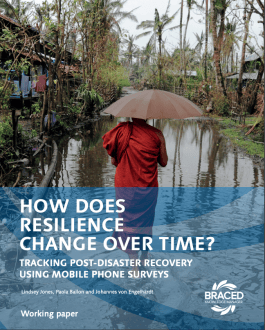
Access: Using mobile phone surveys to track resilience and post-disaster recovery
Lessons from a phone panel survey in Myanmar
What it is: Practice-based lessons from implementing a phone panel survey to study resilience in Myanmar.
Who it is for: Teams designing longitudinal or panel surveys in settings where in-person data collection is difficult.
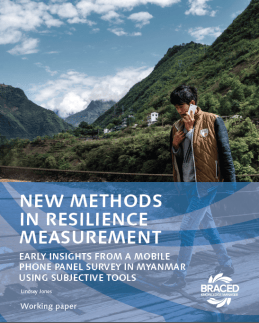
Access: Phone surveys: lessons from Myanmar
How to carry out resilience self-assessments
First of all, it’s important to understand some of the theory and background as to how subjective and objective methods for resilience measurement compare. For a thorough review see this paper in WIRES Climate Change.
Once you’ve decided that you want to run a subjective assessment, you now have to consider how to design your survey module. There are a number of different approaches out there. The approach that I’ve helped to design is called Subjectively-Evaluated Resilience Score, or SERS for short.
SERS is designed to be both simple to use and methodologically robust. Most importantly, it is flexible, allowing evaluators to tailor it to their own needs and mould it to suit a range of different resilience frameworks. SERS is a self-assessed questionnaire module that focuses on household resilience. It works by asking individuals to answer a range of questions about their household’s resilience. Each question targets a specific resilience-related capacity, with answers standardised using a Likert scale. Questions are designed to be cognitively simple, helping ensure that respondents clearly understand each question and can provide a quick and reasoned self-assessment.
Running SERS is straightforward. It is a small survey module that can be placed in any household survey and typically takes roughly three to five minutes to administer. Before starting the module, a survey enumerator reads out a short opening statement. Nine short questions are then asked, with respondents rating the extent to which they agree or disagree with each (ranging from Strongly agree to Strongly disagree).
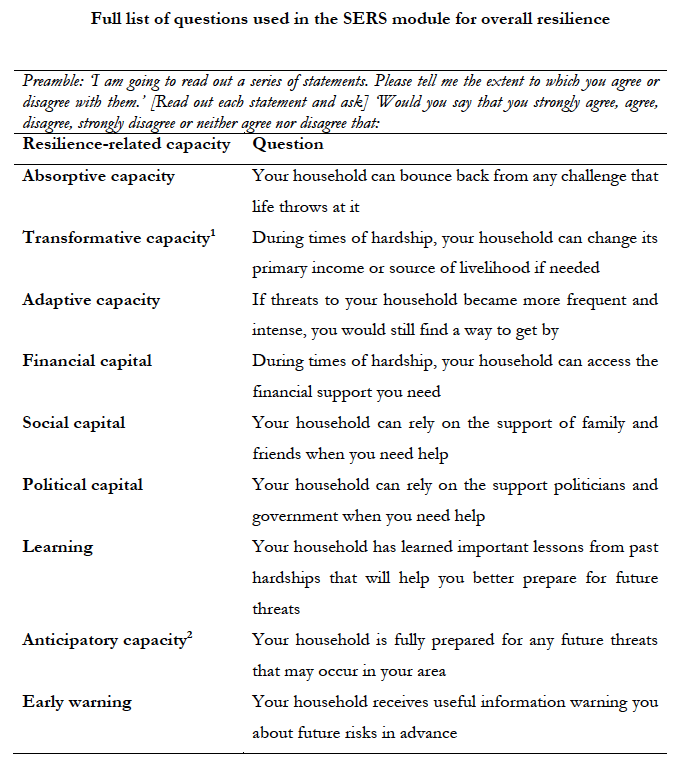
Once answers to each of the questions have been gathered, they are numerically converted. An individual’s answers are then tallied up and used to compute an overall resilience score for each household.
Most importantly, SERS can be designed in a number of different ways. The evaluator’s choices in terms of opening statements, wording, question order and question weighting can each have important implications for how the resilience scores are calculated. Care should be taken in deciding each.
For help tailoring your survey module, use the How-to guide on subjective evaluations of resilience in the practical guides above.
The research below provides further background. If you would like to discuss collaboration, email me.